Best time to dive Cayman Islands
Clear Caribbean walls that drop into the abyss, easy wrecks and stingrays in the shallows.
At a glance
- Best months
- December to June
- Water
- 26–30°CAbout 26°C in February to 29–30°C in August and September. 3 mm, or a shorty in summerWetsuit month by month →
- Visibility
- 20–40 m
- Current
- MildUsually little current; the east ends of the islands can have more
- Certification
- Open WaterMinimum Open Water
- How you dive
- Land-based or liveaboard
When to go
December to June; hurricane season is June to November, peaking August to October.
- JanuaryPeak seasonWater 26–27°CDry
Dry season; some windy days from cold fronts.
- FebruaryPeak seasonWater 26–27°CDry
Coolest water, around 26°C; generally dry.
- MarchPeak seasonWater 26–27°CDry
Dry, sunny and busy with spring breaks.
- AprilPeak seasonWater 26–28°CDry
Calmer seas and very clear water. A good month.
- MayPeak seasonWater 27–28°CSome rain
Calm and warm. A good month; rains start late.
- JunePeak seasonWater 28–29°CSome rain
Hurricane season starts; usually calm, with silversides in the caverns.
- JulyGoodWater 28–29°CSome rain
Warm, calm and clear; storms are possible.
- AugustGoodWater 29–30°CRainy
Warmest water; hurricane risk rising.
- SeptemberOff seasonWater 29–30°CRainy
Peak hurricane season; consider travel insurance.
- OctoberOff seasonWater 28–30°CRainy
Hurricane risk still high; quiet and cheaper.
- NovemberPeak seasonWater 27–29°CSome rain
Hurricane season ends; good conditions return.
- DecemberPeak seasonWater 26–28°CDry
Dry season begins; busy over the holidays.
What makes each month
Each thing worth diving here is rated on its own, month by month: its own season first, then held back a step when the weather is poor or the water is unusually cold for this place. The calendar above takes the best of them. Cold only counts against a month when the highlight does not come with it, so a macro site is never judged by manta-and-visibility rules.
- Walls and wrecks
Very clear water from December to June; August to October is the hurricane peak.
- Weather and sea
- Water °C272727272829293030292827
Overview
The Cayman Islands are three islands in the western Caribbean, south of Cuba: Grand Cayman, Little Cayman and Cayman Brac. They sit on the tops of underwater mountains, so the reefs give way to walls that drop hundreds of metres within a short swim of shore.
Grand Cayman has more than 200 dive sites and some of the Caribbean's best shore diving, with dive shops along Seven Mile Beach and in George Town. The USS Kittiwake, a former US Navy submarine rescue ship, was sunk off Seven Mile Beach in 2011 as an artificial reef. In the North Sound, Stingray City and the Sandbar are shallow sandbanks where southern stingrays gather. Little Cayman's Bloody Bay Wall is one of the Caribbean's best-known wall dives, starting at about 6 m. Cayman Brac has the MV Captain Keith Tibbetts, a Russian-built frigate sunk in 1996.
The water is about 26°C in February and up to about 30°C in late summer, and visibility is often 25–30 m. December to June is the main season. Hurricane season runs from June to November, with the highest risk from August to October; diving continues on most days, but storms can close the islands.
Getting there and how you dive
Getting there
Fly to Grand Cayman (Owen Roberts International Airport), with direct flights from the US, Canada and London. Small planes connect to Little Cayman and Cayman Brac.
Who it suits
Open Water is enough for most diving, including the tops of the walls. Good buoyancy matters on the walls, which drop far beyond recreational depth.
Dive sites
- USS KittiwakeFormer US Navy submarine rescue ship sunk off Seven Mile Beach in 2011, about 76 m long, lying in about 20 m; easy to explore.
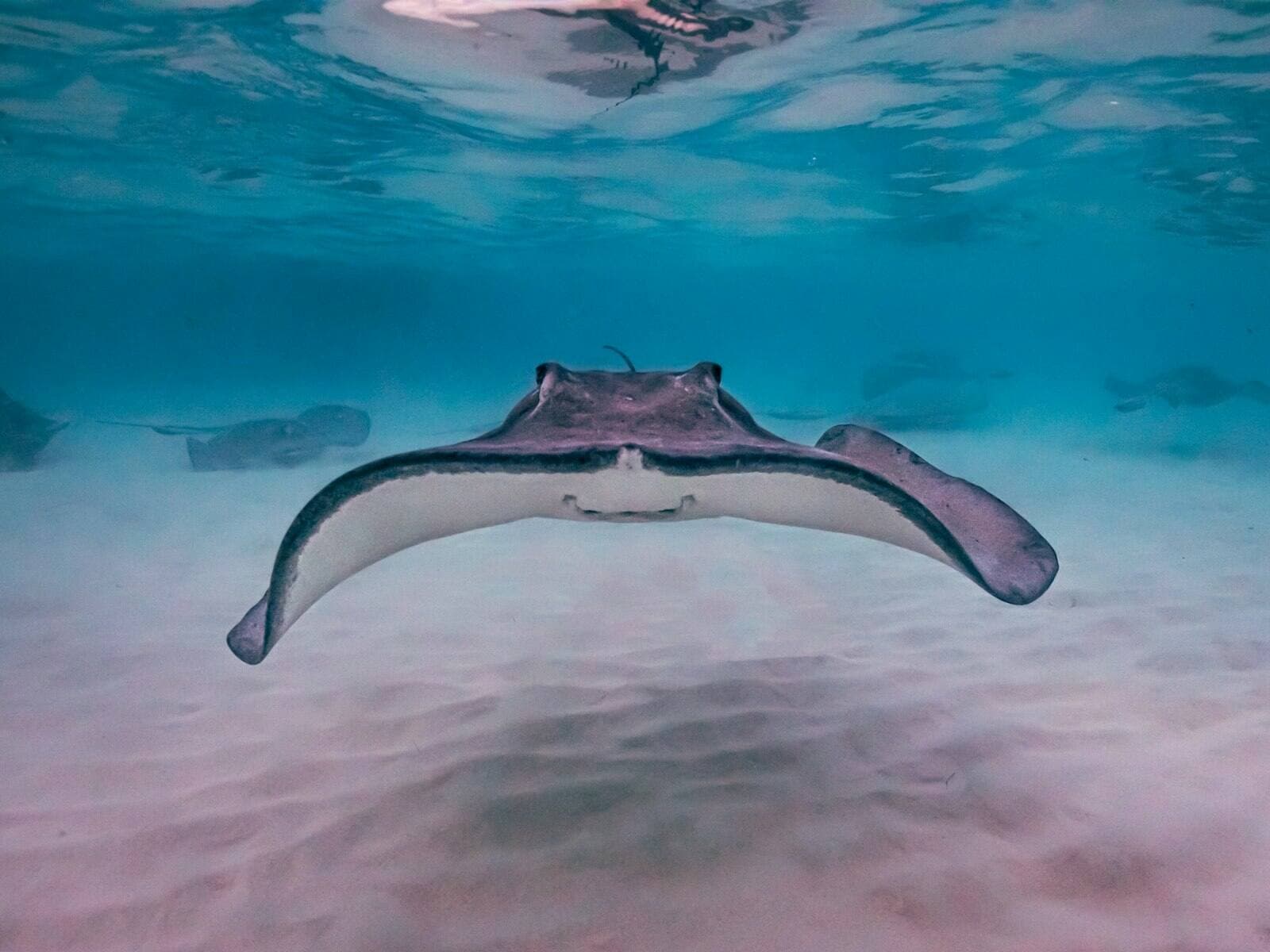
- Stingray CityShallow sandbank in the North Sound where southern stingrays gather; about 4 m, also snorkelled at the Sandbar.
- Bloody Bay WallLittle Cayman wall from about 6 m dropping vertically into very deep water; sponges, groupers and turtles.
- Jackson's BightLittle Cayman wall with a sand channel and swim-throughs; reef sharks and eagle rays at times.
- Eden RockShore dive in George Town with coral and caverns full of silversides in summer.
- Devil's GrottoNext to Eden Rock: tunnels and grottoes where tarpon gather in summer.
- MV Captain Keith TibbettsRussian-built frigate sunk off Cayman Brac in 1996, now broken in two, about 6–30 m.
- BabylonPinnacle and wall on Grand Cayman's north side with big sponges and black coral.
- Doc PoulsonSmall cable-laying ship sunk as an artificial reef off West Bay, Grand Cayman, at about 18 m.
- Trinity CavesGrand Cayman wall with canyons and swim-throughs.
- Big TunnelsNorthwest Point site with a large arch and swim-throughs on the wall.
- Orange CanyonWest-wall canyons with orange elephant-ear sponges.
- Ghost MountainLarge pinnacle off the north wall, deeper dive.
- Snapper HoleNetwork of chutes, tunnels and caverns at about 20 m on the East End.
- Great Wall (Little Cayman)Part of Bloody Bay with a vertical wall starting in a few metres.
- Three Fathom Wall (Little Cayman)Wall that starts at about 6 m in Bloody Bay.
- Mixing Bowl (Little Cayman)Where Bloody Bay and Jackson walls meet; dense fish and coral.
- Lighthouse PointShore dive on the north-west of Grand Cayman.
- Wreck of the Balboa (George Town)Shallow freighter wreck in George Town harbour; good night dive with permission.
- Oro Verde (Seven Mile Beach)Shallow wreck off Seven Mile Beach, good for beginners.
- Bonnie's ArchShore dive with a coral arch on the west coast.
- Tarpon Terrace (East End)East End site in the High Rock area with tarpon.
What you'll see
Know the risks
- Hurricane season, June to November
- Walls drop past 300 m: watch your depth
- Northwest winds in winter can close the north and west sides on some days
Plan the trip
- Liveaboards
Liveaboards reach sites day boats can't. Compare routes, nights and prices.
How to choose a liveaboard - Dive shops
Where Cayman Islands dive centres are based and what to check before you book. Shop list in progress.
How to choose a dive shop - Dates and people
Post your dates and how many of you. Divers who know the boats and shops, or are going the same weeks, reply in the community.
Find divers / ask dates - Dive insurance
Most travel policies exclude scuba or cap the depth. Check yours covers diving before you go.
Dive accident cover from DAN ↗
Some of these links may earn us a commission at no cost to you. It never changes what we recommend. How this site is funded
Ask other divers
Questions
When is the best time to dive Cayman Islands?
December to June; hurricane season is June to November, peaking August to October. Peak months on our calendar: January, February, March, April, May, June, November, December.
What is the water temperature in Cayman Islands?
About 26°C in February to 29–30°C in August and September. 3 mm, or a shorty in summer.
Can Open Water divers dive Cayman Islands?
Open Water is enough for most diving, including the tops of the walls. Good buoyancy matters on the walls, which drop far beyond recreational depth.
How strong is the current in Cayman Islands?
Usually little current; the east ends of the islands can have more.
What should divers watch out for in Cayman Islands?
Hurricane season, June to November. Walls drop past 300 m: watch your depth. Northwest winds in winter can close the north and west sides on some days.
Sources
- PADI blog: Best dive sites in the Cayman Islands
- Divernet: Cayman Islands, a tale of three islands
- SDI: Grand Cayman
- Scuba Diving: The Cayman Islands, an unforgettable underwater world
- Cayman Compass: best Cayman Islands dive sites
Last reviewed 2026-11. Where sources disagree we use the more conservative range.