Best time to dive Chuuk (Truk Lagoon)
The Japanese fleet sunk in 1944: cargo holds full of trucks, aircraft and shells, in warm, sheltered water.
At a glance
- Best months
- December to April is the drier season
- Water
- 27–30°CAbout 27–28°C in the northern winter and 28–30°C in summer and autumn. A 3 mm suit is enoughWetsuit month by month →
- Visibility
- 12–30 m
- Current
- MildLittle or no current inside the lagoon; the outer reef passes can run
- Certification
- AdvancedSome sites possible for Open Water
- How you dive
- Liveaboard or land-based
When to go
December to April is the drier season; the lagoon can be dived all year.
- JanuaryPeak seasonWater 27–28°CSome rain
Drier season. Trade winds bring a chop on the crossing, but the lagoon itself stays calm.
- FebruaryPeak seasonWater 27–28°CSome rain
Drier season and usually the best visibility of the year.
- MarchPeak seasonWater 27–28°CSome rain
Drier season, settled conditions. A popular month for wreck trips.
- AprilPeak seasonWater 27–29°CSome rain
End of the drier months; still good visibility.
- MayGoodHeld at Good by the weatherWater 28–29°CRainy
Rain becomes more frequent. Short showers rarely stop diving inside the lagoon.
- JuneGoodHeld at Good by the weatherWater 28–29°CRainy
Wetter months begin. Visibility can drop after heavy rain.
- JulyGoodHeld at Good by the weatherWater 28–30°CRainy
Wet and warm. Diving continues; fewer boats are in the lagoon.
- AugustGoodHeld at Good by the weatherWater 28–30°CRainy
Wet and warm. Typhoons usually form further west, but storms can pass.
- SeptemberGoodHeld at Good by the weatherWater 28–30°CRainy
Warmest water. Rain is frequent but diving goes on.
- OctoberGoodHeld at Good by the weatherWater 28–30°CRainy
Wet. Good month for quiet liveaboard trips.
- NovemberGoodHeld at Good by the weatherWater 28–29°CRainy
Rain starts to ease towards the end of the month.
- DecemberPeak seasonWater 27–29°CSome rain
The drier season begins; holiday departures fill early.
What makes each month
Each thing worth diving here is rated on its own, month by month: its own season first, then held back a step when the weather is poor or the water is unusually cold for this place. The calendar above takes the best of them. Cold only counts against a month when the highlight does not come with it, so a macro site is never judged by manta-and-visibility rules.
- WWII wrecks
The lagoon wrecks can be dived all year; December to April is drier with the best visibility.
- Weather and sea
- Water °C282828282929292929292928
Overview
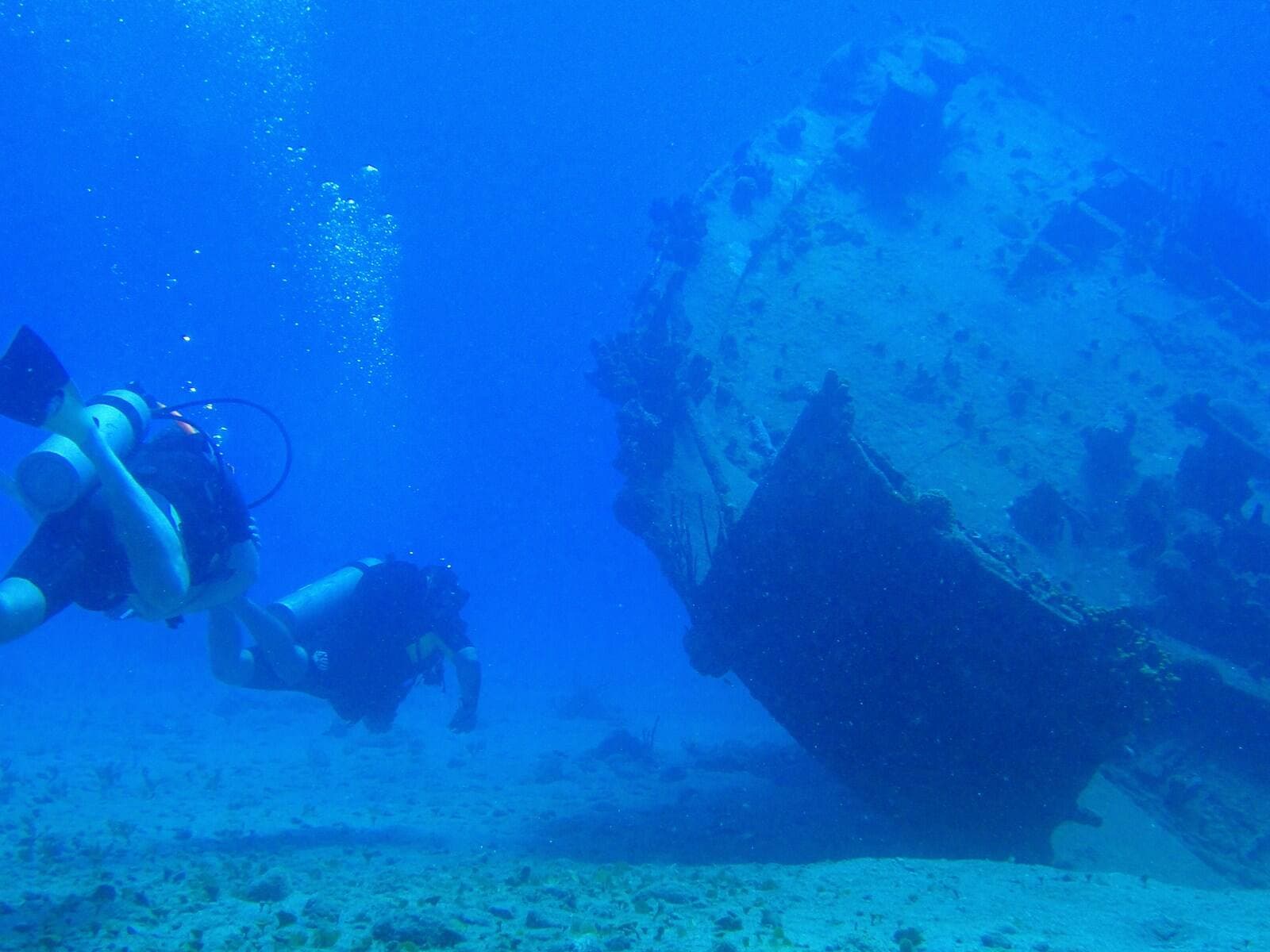
Chuuk Lagoon, still widely known as Truk Lagoon, was the Imperial Japanese Navy's forward base in the central Pacific. In February 1944 American carrier aircraft attacked the anchorage in Operation Hailstone and sank dozens of ships and hundreds of aircraft. Most of them still lie where they sank, in a ring of reef about 60 km across.
The wrecks are the reason to come. Many still carry their cargo: aircraft parts, trucks, tanks, shells and sake bottles. Seventy years of coral growth cover the masts and rails. The upper decks of ships such as the Fujikawa Maru are within reach of Open Water divers on a guided dive, but the best-known holds and engine rooms sit at 25–40 m, so most visitors come with Advanced Open Water, nitrox and some wreck experience. Technical divers come for the deeper ships.
The water is about 27–30°C all year. Visibility inside the lagoon is usually 12–25 m, lower after heavy rain. December to April is the drier season, but diving goes on all year; a handful of liveaboards and two or three land-based dive operations on Weno serve the lagoon.
Getting there and how you dive
Getting there
United Airlines' Island Hopper connects Weno (Chuuk International Airport) with Guam and Honolulu several times a week.
Who it suits
Open Water divers can see the upper decks of several wrecks with a guide. Most holds and engine rooms are 25–40 m and need Advanced Open Water, nitrox and wreck training to enter.
Dive sites
- Fujikawa MaruAircraft transport upright at about 35 m, decks from 10–18 m; Zero fighter parts in the holds. The classic first wreck.
- Shinkoku MaruLarge tanker covered in soft coral and anemones, with an operating table in the sick bay.
- San Francisco MaruThe 'Million Dollar Wreck': three tanks on deck and trucks and mines in the holds. Deck at about 45 m, for experienced divers.
- Nippo MaruArtillery, a tank and trucks on and around the deck at about 25–40 m.
- Heian MaruSubmarine tender lying on its side, one of the largest wrecks in the lagoon; periscopes in the passageway.
- Rio de Janeiro MaruPassenger liner turned submarine tender, on its side; large guns at the stern and beer bottles in the holds.
- Yamagiri MaruCargo ship in the western anchorage with huge 18-inch shells for battleship guns in the hold.
- Hoki MaruHolds packed with trucks, a bulldozer and a steamroller, at about 20–48 m.
- Betty BomberMitsubishi G4M bomber in shallow water off Eten Island, about 18 m; an easy dive between wrecks.
- Sankisan MaruCargo ship near Uman with trucks and ammunition in the holds; the stern lies deeper.
- Kensho MaruCargo ship sitting upright with an engine room that experienced divers can enter.
- Gosei MaruSmaller cargo ship on a slope, with a torpedo in the hold; shallower than most.
- Kiyosumi MaruPassenger-cargo ship with guides' artefact display near the ascent line.
- Aikoku MaruLarge armed transport with an intact bridge, telegraph and binnacle; deep.
- Hanakawa MaruCargo ship covered in soft coral off Tol; one of the most colourful wrecks.
- Unkai MaruAbout 90 m freighter, mostly empty when sunk; easy to explore.
- Fumitsuki97 m Japanese destroyer, a purpose-built warship rather than a converted merchant.
- I-169 ShinoharaJapanese submarine lost in the lagoon in April 1944; war grave, viewed from outside.
- Shotan MaruSteam cargo ship built in 1943 and lost the next year.
- Yubae MaruSmall cargo wreck in the lagoon, less visited.
What you'll see
Know the risks
- Depth: most wrecks sit at 30–40 m, so no-decompression time is short
- Penetration hazards: silt, tight passages and unexploded ordnance; do not touch munitions
- The nearest chamber is far away; plan conservative profiles
Plan the trip
- Liveaboards
Liveaboards reach sites day boats can't. Compare routes, nights and prices.
How to choose a liveaboard - Dive shops
Where Chuuk (Truk Lagoon) dive centres are based and what to check before you book. Shop list in progress.
How to choose a dive shop - Dates and people
Post your dates and how many of you. Divers who know the boats and shops, or are going the same weeks, reply in the community.
Find divers / ask dates - Dive insurance
Most travel policies exclude scuba or cap the depth. Check yours covers diving before you go.
Dive accident cover from DAN ↗
Some of these links may earn us a commission at no cost to you. It never changes what we recommend. How this site is funded
Ask other divers
Questions
When is the best time to dive Chuuk (Truk Lagoon)?
December to April is the drier season; the lagoon can be dived all year. Peak months on our calendar: January, February, March, April, December.
What is the water temperature in Chuuk (Truk Lagoon)?
About 27–28°C in the northern winter and 28–30°C in summer and autumn. A 3 mm suit is enough.
Can Open Water divers dive Chuuk (Truk Lagoon)?
Open Water divers can see the upper decks of several wrecks with a guide. Most holds and engine rooms are 25–40 m and need Advanced Open Water, nitrox and wreck training to enter.
How strong is the current in Chuuk (Truk Lagoon)?
Little or no current inside the lagoon; the outer reef passes can run.
What should divers watch out for in Chuuk (Truk Lagoon)?
Depth: most wrecks sit at 30–40 m, so no-decompression time is short. Penetration hazards: silt, tight passages and unexploded ordnance; do not touch munitions. The nearest chamber is far away; plan conservative profiles.
Sources
- Bluewater Dive Travel: Scuba diving in Truk Lagoon
- Underwater Photography Guide: Diving Truk Lagoon
- Shearwater: The top 8 wrecks of Truk Lagoon
- PADI Travel: Chuuk (Truk Lagoon)
- US National Park Service: War in Paradise, Truk Lagoon wreck table
- Pacific Wrecks: Truk Lagoon
Last reviewed 2026-11. Where sources disagree we use the more conservative range.