Best time to dive Iceland (Silfra)
Drift through glacial meltwater between the North American and Eurasian plates, with visibility often over 100 m.
At a glance
- Best months
- All year
- Water
- 2–4°CSilfra stays about 2–4°C all year. Drysuit, thick undersuit, hood and dry or thick glovesWetsuit month by month →
- Visibility
- 50–100 m
- Current
- MildA gentle flow carries you through Silfra; no real current
- Certification
- AdvancedSome sites possible for Open Water
- How you dive
- Land-based
When to go
All year; May to September has long days and milder air, while winter brings snow and short daylight.
- JanuaryGoodHeld at Good by the weatherWater 2–4°CSome rain
Snow and about five hours of daylight; Silfra is still diveable.
- FebruaryGoodHeld at Good by the weatherWater 2–4°CSome rain
Cold air and short days; very clear water.
- MarchGoodHeld at Good by the weatherWater 2–4°CSome rain
Days lengthening; still winter on land.
- AprilGoodHeld at Good by the weatherWater 2–4°CSome rain
Spring; snow melting around the park.
- MayPeak seasonWater 2–4°CSome rain
Long days and milder air. A good month.
- JunePeak seasonWater 2–4°CSome rain
Midnight sun; busy summer season.
- JulyPeak seasonWater 2–4°CSome rain
Warmest air; book ahead.
- AugustPeak seasonWater 2–4°CSome rain
Long days; good conditions.
- SeptemberPeak seasonWater 2–4°CSome rain
Autumn colours; fewer people.
- OctoberGoodHeld at Good by the weatherWater 2–4°CSome rain
Shorter days; weather more changeable.
- NovemberGoodHeld at Good by the weatherWater 2–4°CSome rain
Cold and dark; northern lights season.
- DecemberGoodHeld at Good by the weatherWater 2–4°CSome rain
Shortest days; dive in the middle of the day.
What makes each month
Each thing worth diving here is rated on its own, month by month: its own season first, then held back a step when the weather is poor or the water is unusually cold for this place. The calendar above takes the best of them. Cold only counts against a month when the highlight does not come with it, so a macro site is never judged by manta-and-visibility rules.
- Silfra fissure
The water is 2–4°C and very clear in every month; summer brings long days and milder air.
- Weather and sea
- Water °C333333333333
Overview
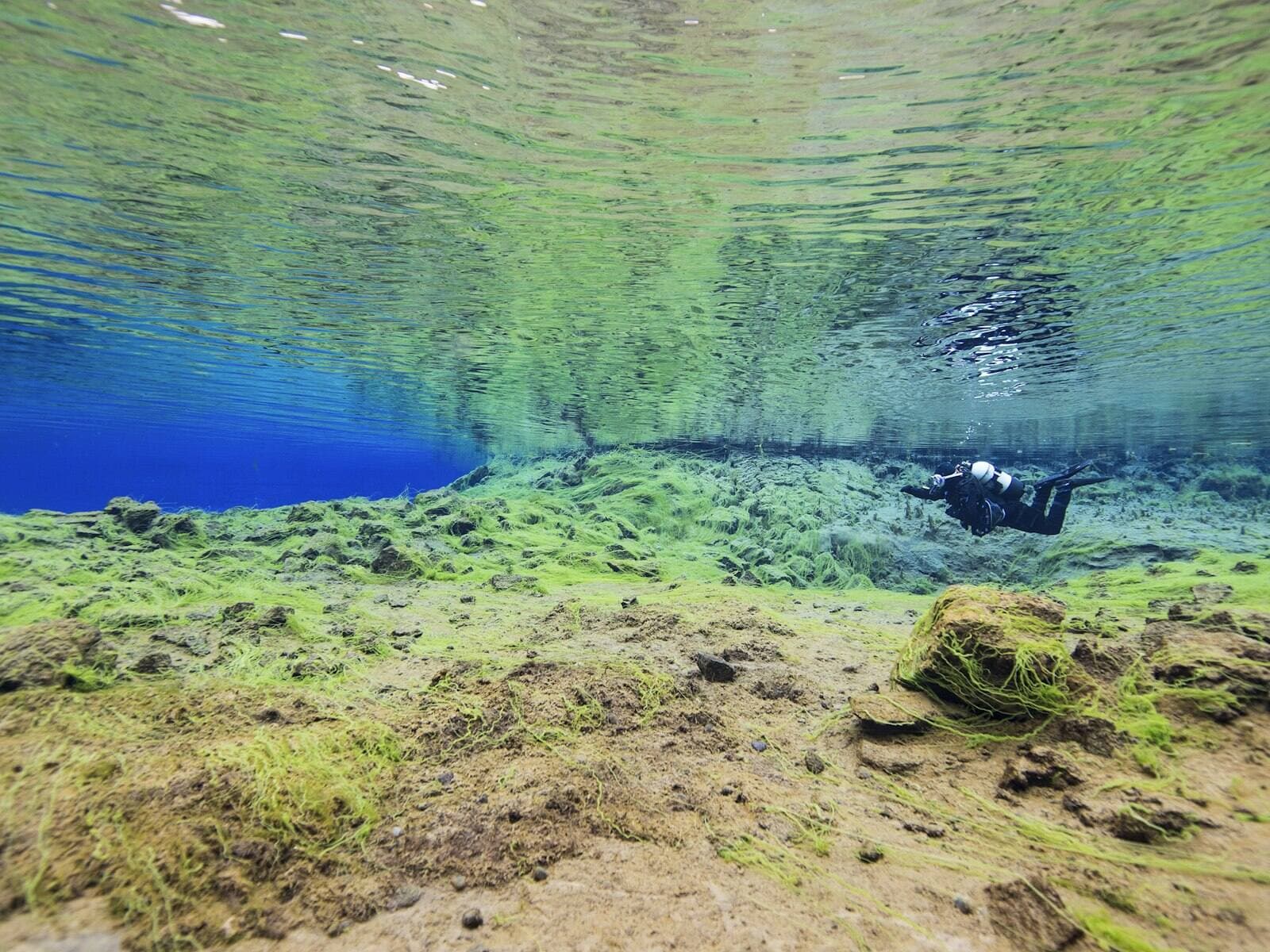
Silfra is a fissure in Þingvellir National Park, about 45 minutes by road from Reykjavík, where the North American and Eurasian plates are pulling apart. It is filled with meltwater from the Langjökull glacier that has filtered through lava rock for decades, so the water is extremely clear, often with visibility over 100 m.
A Silfra dive follows the fissure through narrow cracks into Silfra Hall and the long Silfra Cathedral, then ends in the shallow, open Silfra Lagoon. There is little life apart from bright green algae; people dive here for the clarity, the light and the geology. Operators also run dives at Davíðsgjá, a fissure in Lake Þingvallavatn. In the north, Strýtan in Eyjafjörður is a geothermal chimney rising from the seabed, and on the east coast the El Grillo, a tanker sunk in 1944, lies in Seyðisfjörður.
The water in Silfra stays about 2–4°C all year. Divers need a drysuit certification or recent drysuit experience, and the park sets a maximum depth of 18 m. Snorkelling in a drysuit is also possible with no experience.
Getting there and how you dive
Getting there
Fly to Keflavík. Silfra is about 45 minutes by road from Reykjavík; most operators offer pick-up or a meeting point at the park.
Who it suits
Open Water plus a drysuit certification, or about 10 logged drysuit dives in the last two years, signed by an instructor. Maximum depth in Silfra is 18 m.
Dive sites
- Silfra Big CrackNarrow entrance section of the fissure, with the plates close on both sides.
- Silfra HallWider, deeper section of the fissure with huge boulders and clear blue water.
- Silfra CathedralLong, deep channel of the fissure where you can see from one end to the other.
- Silfra LagoonShallow, open end of the dive with green algae and light.
- DavíðsgjáFissure on the shore of Lake Þingvallavatn, with lava walls and algae.
- StrýtanGeothermal chimney rising from about 70 m to about 15 m below the surface in Eyjafjörður, venting warm fresh water.
- El GrilloTanker sunk by German aircraft in 1944 in Seyðisfjörður, at about 30–45 m.
- KleifarvatnVolcanic lake on Reykjanes with geothermal bubbles rising from the bottom.
- ArnarnesstrýturShallow hydrothermal chimneys in Eyjafjörður near Strýtan.
- NesgjáFissure in north Iceland filled with clear spring water.
What you'll see
Know the risks
- Water about 2–4°C: cold-water and drysuit skills are essential
- Proof of drysuit experience is checked; no proof, no dive
- Short dives (about 30–40 minutes) because of the cold
Plan the trip
- Dive shops
Where Iceland (Silfra) dive centres are based and what to check before you book. Shop list in progress.
How to choose a dive shop - Dates and people
Post your dates and how many of you. Divers who know the boats and shops, or are going the same weeks, reply in the community.
Find divers / ask dates - Dive insurance
Most travel policies exclude scuba or cap the depth. Check yours covers diving before you go.
Dive accident cover from DAN ↗
Some of these links may earn us a commission at no cost to you. It never changes what we recommend. How this site is funded
Ask other divers
Questions
When is the best time to dive Iceland (Silfra)?
All year; May to September has long days and milder air, while winter brings snow and short daylight. Peak months on our calendar: May, June, July, August, September.
What is the water temperature in Iceland (Silfra)?
Silfra stays about 2–4°C all year. Drysuit, thick undersuit, hood and dry or thick gloves.
Can Open Water divers dive Iceland (Silfra)?
Open Water plus a drysuit certification, or about 10 logged drysuit dives in the last two years, signed by an instructor. Maximum depth in Silfra is 18 m.
How strong is the current in Iceland (Silfra)?
A gentle flow carries you through Silfra; no real current.
What should divers watch out for in Iceland (Silfra)?
Water about 2–4°C: cold-water and drysuit skills are essential. Proof of drysuit experience is checked; no proof, no dive. Short dives (about 30–40 minutes) because of the cold.
Sources
- Adventures.com: Scuba diving in Silfra
- Guide to Iceland: Diving tour in Silfra
- DIVE.IS: Silfra and Davíðsgjá diving combo
- Gear Patrol: The world's most spectacular dive isn't in an ocean
- Scuba Diver Life: best scuba diving in Iceland
Last reviewed 2026-11. Where sources disagree we use the more conservative range.