Best time to dive Komodo
Mantas, sharks and some of the strongest currents in diving.
At a glance
- Best months
- April to November
- Water
- 20–29°CNorth 25–28°C; south can drop to about 20°C. Bring 5 mm for the southWetsuit month by month →
- Visibility
- 10–30 m
- Current
- StrongStrong, with down-currents
- Certification
- AdvancedMinimum Advanced
- How you dive
- Liveaboard or land-based
When to go
April to November (dry season); December to March is wetter but good for mantas.
- JanuaryGoodBest for: North and central reefs, Manta rays · Held at Good by the weatherWater 26–29°CRainy
Wet season. Mantas are often more numerous, and the south is warmer than in the dry season. Fewer boats run.
- FebruaryGoodBest for: North and central reefs, Manta rays · Held at Good by the weatherWater 26–29°CRainy
Wet, with rough seas on some days, but good manta encounters and fewer divers.
- MarchGoodBest for: North and central reefs, Manta raysWater 26–29°CRainy
The wet season ends; plankton-rich water still brings mantas.
- AprilPeak seasonBest for: North and central reefsWater 26–29°CSome rain
The dry season begins and seas calm down. Good conditions in the north and centre.
- MayPeak seasonBest for: North and central reefsWater 25–29°CDry
Dry, calm and clear in the north; one of the best all-round months.
- JunePeak seasonBest for: North and central reefsWater 23–28°CDry
Dry and clear. The south starts to cool.
- JulyPeak seasonBest for: North and central reefsWater 21–28°CDry
Peak liveaboard season. Water in the south can drop to about 20–22°C; the north stays near 27–28°C.
- AugustPeak seasonBest for: North and central reefsWater 20–27°CDry
Busy peak season and the coldest water in the south. Bring 5 mm and a hood for southern sites.
- SeptemberPeak seasonBest for: North and central reefsWater 20–27°CDry
Excellent visibility in the north; cold water continues in the south.
- OctoberPeak seasonBest for: North and central reefsWater 22–28°CDry
Still dry and clear; the south begins to warm.
- NovemberGoodBest for: North and central reefs, Manta raysWater 25–29°CSome rain
Rains begin late in the month, and mantas become more frequent.
- DecemberPeak seasonBest for: Manta raysWater 26–29°CRainy
The wet season starts. Diving continues, with more mantas and fewer boats.
What makes each month
Each thing worth diving here is rated on its own, month by month: its own season first, then held back a step when the weather is poor or the water is unusually cold for this place. The calendar above takes the best of them. Cold only counts against a month when the highlight does not come with it, so a macro site is never judged by manta-and-visibility rules.
- North and central reefs
Dry, calm and clear in the north from April to October. The south cools to 20–22°C from July to September, so bring 5 mm and a hood there.
- Manta rays
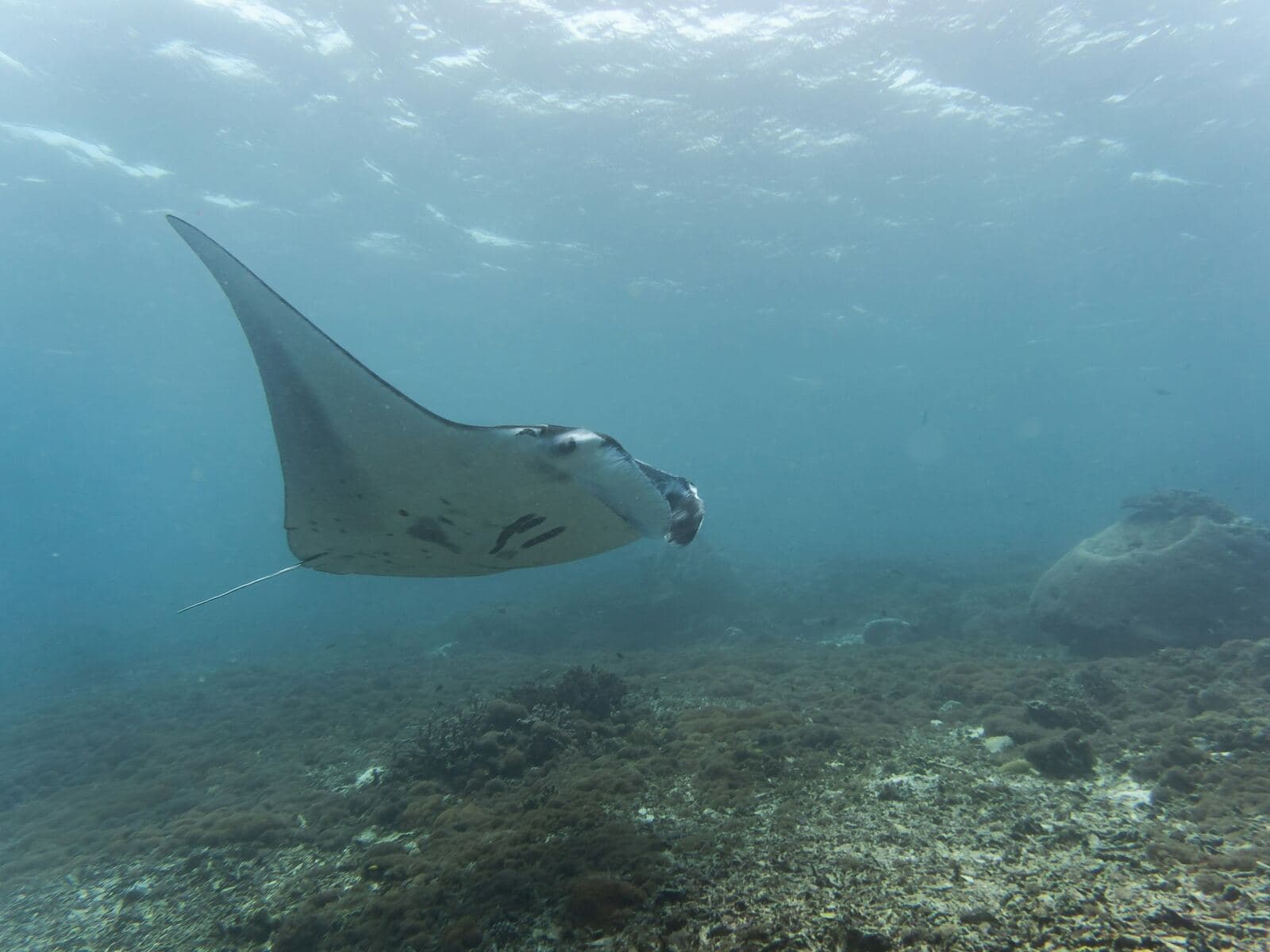
Mantas are often more numerous from December to February, when the south is warmer; fewer boats run in the wet season.
- Weather and sea
- Water °C282828282726252424252728
Overview
Komodo National Park, between the islands of Sumbawa and Flores in Indonesia, is famous on land for its dragons and underwater for its current. Tidal water pours between the Indian Ocean and the Flores Sea through narrow channels, and that flow feeds some of the richest marine life in Southeast Asia: manta rays, reef sharks, turtles and dense schools of fish.
The same current makes Komodo one of the more demanding destinations on this list. Flow can be strong, down-currents occur, and conditions change quickly with the tide. We recommend Advanced Open Water and around 50 logged dives before tackling the strong-current sites. Good operators plan dives around the tide tables and choose sheltered sites when the flow is too strong.
Temperature varies more than visitors expect. Northern sites are usually 25 to 28°C. In the south, upwelling can bring water down to about 20°C, with sharp thermoclines, so a 5 mm suit is sensible there. July and August are usually the coolest months.
The dry season from April to November is the main dive season, with calmer seas and better visibility. December to March is wetter and some days are cancelled, but it is also the best time for manta rays, which gather in large numbers. Divers stay in Labuan Bajo on Flores and take day boats, or join a liveaboard to reach the remote northern and southern sites.
Who it suits
Advanced Open Water. Around 50 logged dives before strong-current sites.
Dive sites
- Batu BolongPinnacle in the current with a sheltered side; dense fish, sharks, turtles. Strong flow, Advanced.
- Castle RockSubmerged pinnacle; grey reef sharks, giant trevally, big schools. Strong, variable current; Advanced.
- Manta Point (Makassar Reef)Gentle drift past manta cleaning stations; suits most levels, more mantas in the wet season.
- Cannibal Rock (south Komodo)Colourful soft coral and macro, frogfish and pygmy seahorses; cooler water, usually by liveaboard.
- Crystal RockSubmerged rock with clear water, big fish and strong current.
- Siaba Besar (Turtle City)Sheltered bay with turtles and easy conditions.
- Tatawa BesarReef with orange soft coral and a gentle drift.
- Pink Beach (Pantai Merah)Easy reef by the pink-sand beach; good for snorkel and macro.
- Golden PassageChannel between Gili Lawa Darat and Komodo with a fast drift over coral; for experienced divers.
- Manta Alley (south Komodo)The famous manta aggregation site in south Komodo; cold, surgy water. Usually by liveaboard.
- Yellow Wall of TexasWall covered in yellow soft coral and sea cucumbers; a macro dive in the south.
- Three Sisters (Padar)Three submerged pinnacles near Padar from about 5 to 40 m; colourful and fishy.
- Batu TigaChannel with strong current and reef sharks. Experienced divers only.
- Shotgun (The Cauldron)Bowl and narrow channel off Gili Lawa that pushes divers through in strong current; mantas at times.
- Tatawa KecilExposed rocks with stronger current than Tatawa Besar; pinnacles and fish life.
- MawanSmall island near Manta Point with a quieter manta cleaning station.
- Sebayur KecilEasy reef close to Labuan Bajo; good for check dives, sometimes mobula rays.
- Lighthouse (Gili Lawa Laut)Reef by the lighthouse in the north; drift with turtles and sharks when the current runs.
- Pengah KecilSmall island with a wall and coral; easy to moderate.
- Siaba KecilReef near Siaba Besar with turtles; good for most levels.
- WainiluMuck site off Rinca for macro photographers.
- Pillarsteen (Padar)Rock pinnacle off Padar with caves and swim-throughs.
- Torpedo Alley (Padar)Muck site north of Padar Bay; torpedo rays on the sand.
What you'll see
| Animal | J | F | M | A | M | J | J | A | S | O | N | D |
|---|---|---|---|---|---|---|---|---|---|---|---|---|
| Manta raysMore mantas in the wet season, December to March. | January: best | February: best | March: best | April: possible | May: possible | June: possible | July: possible | August: possible | September: possible | October: possible | November: possible | December: best |
Know the risks
- Strong current
- Down-currents
- Cold thermoclines in the south
Compare
Plan the trip
- Liveaboards
Liveaboards reach sites day boats can't. 6 boats sail here; compare routes, nights and prices.
See the 6 Komodo boats - Dive shops
4 dive centres and day boats at Komodo, where they are based and what to check before you book.
See Komodo dive shops - Dates and people
Post your dates and how many of you. Divers who know the boats and shops, or are going the same weeks, reply in the community.
Find divers / ask dates - Dive insurance
Remote sites and strong currents make evacuation costly. Check your policy covers diving to the depth you plan.
Dive accident cover from DAN ↗
Some of these links may earn us a commission at no cost to you. It never changes what we recommend. How this site is funded
Ask other divers
Questions
When is the best time to dive Komodo?
April to November (dry season); December to March is wetter but good for mantas. Peak months on our calendar: April, May, June, July, August, September, October, December.
What is the water temperature in Komodo?
North 25–28°C; south can drop to about 20°C. Bring 5 mm for the south.
Can Open Water divers dive Komodo?
Advanced Open Water. Around 50 logged dives before strong-current sites.
How strong is the current in Komodo?
Strong, with down-currents.
What should divers watch out for in Komodo?
Strong current. Down-currents. Cold thermoclines in the south.
Sources
- Komodo Resort: Diving conditions
- PADI Travel: Komodo
- Original Diving: Best time to dive in Komodo
- Komodo Resort: Komodo dive sites
- Original Diving: Best dive sites in Komodo
- Labuan Bajo weather by month (weather2travel)
- Dragon Dive Komodo: Komodo dive sites directory
Last reviewed 2026-10. Where sources disagree we use the more conservative range.