Best time to dive North Carolina
Sand tiger sharks hanging over WWII wrecks and a German U-boat, in Gulf Stream water.
At a glance
- Best months
- June to September
- Water
- 16–28°CAbout 22–28°C at depth in summer when the Gulf Stream is close, much colder inshore in winter. 3–5 mm in summer; there can be cold thermoclinesWetsuit month by month →
- Visibility
- 6–30 m
- Current
- StrongOften strong: the Gulf Stream and the Labrador Current meet off Cape Hatteras. Descents on the anchor line
- Certification
- AdvancedMinimum Advanced
- How you dive
- Land-based
When to go
June to September; most boats run May to October, and winter seas are rough.
- JanuaryOff seasonWater 15–19°CSome rain
Few boats run; rough winter seas offshore.
- FebruaryOff seasonWater 14–18°CSome rain
Coldest month; mostly no offshore diving.
- MarchOff seasonWater 15–19°CSome rain
Still rough; the odd calm-day charter.
- AprilOff seasonWater 17–21°CSome rain
Season starting for some operators, weather permitting.
- MayGoodWater 20–23°CSome rain
Boats running regularly; water warming, visibility variable.
- JunePeak seasonWater 22–25°CSome rain
Good season begins; sand tigers commonly reported on the wrecks.
- JulyPeak seasonWater 24–27°CRainy
Warm Gulf Stream water and often the best visibility; afternoon thunderstorms.
- AugustPeak seasonWater 25–28°CRainy
Warmest water; hurricane season picks up.
- SeptemberGoodHeld at Good by the weatherWater 24–27°CSome rain
Still warm; peak hurricane month, check forecasts.
- OctoberGoodWater 22–25°CSome rain
Season ending; fronts and wind more frequent.
- NovemberOff seasonWater 19–23°CSome rain
Few trips; rough seas.
- DecemberOff seasonWater 16–20°CSome rain
Off season.
What makes each month
Each thing worth diving here is rated on its own, month by month: its own season first, then held back a step when the weather is poor or the water is unusually cold for this place. The calendar above takes the best of them. Cold only counts against a month when the highlight does not come with it, so a macro site is never judged by manta-and-visibility rules.
- Wrecks and sand tiger sharks
Boats run regularly from May to October; warm Gulf Stream water and the best visibility from June to August, when sand tigers are commonly reported.
- Weather and sea
- Water °C171617192224262726242118
Cold for here
Overview
The coast of North Carolina is called the Graveyard of the Atlantic. Shifting shoals off Cape Hatteras and Cape Lookout wrecked ships for centuries, and in 1942 German U-boats sank dozens of tankers and freighters here. Many of those wrecks now lie at 25–40 m, and the warm, clear Gulf Stream that sweeps close to the coast makes them some of the best wreck dives in the US.
Most diving is from Morehead City and Beaufort on the Crystal Coast. The best-known wrecks are the U-352, a German submarine sunk by a US Coast Guard cutter in 1942, and the tankers Papoose and the freighter Spar, where large sand tiger sharks often hang motionless over the hull. Sources disagree on whether the sharks are present all year or gather mainly in summer, so ask an operator about recent sightings. Further north, Hatteras has its own wrecks closer to the Gulf Stream.
These are offshore dives in open ocean, with long boat rides, current and depth. The season is roughly May to October; water at depth in summer is about 22–28°C, and visibility on the outer wrecks can reach 30 m on good days.
Getting there and how you dive
Getting there
Fly to New Bern (EWN) or Raleigh-Durham (RDU) and drive to Morehead City or Beaufort; Hatteras is reached by road and ferry along the Outer Banks.
Who it suits
Advanced Open Water; most wrecks lie at 25–40 m, offshore, with current. Nitrox and wreck experience help.
Dive sites
- U-352German Type VIIC U-boat sunk by the USCGC Icarus in 1942, about 35 m; usually current.
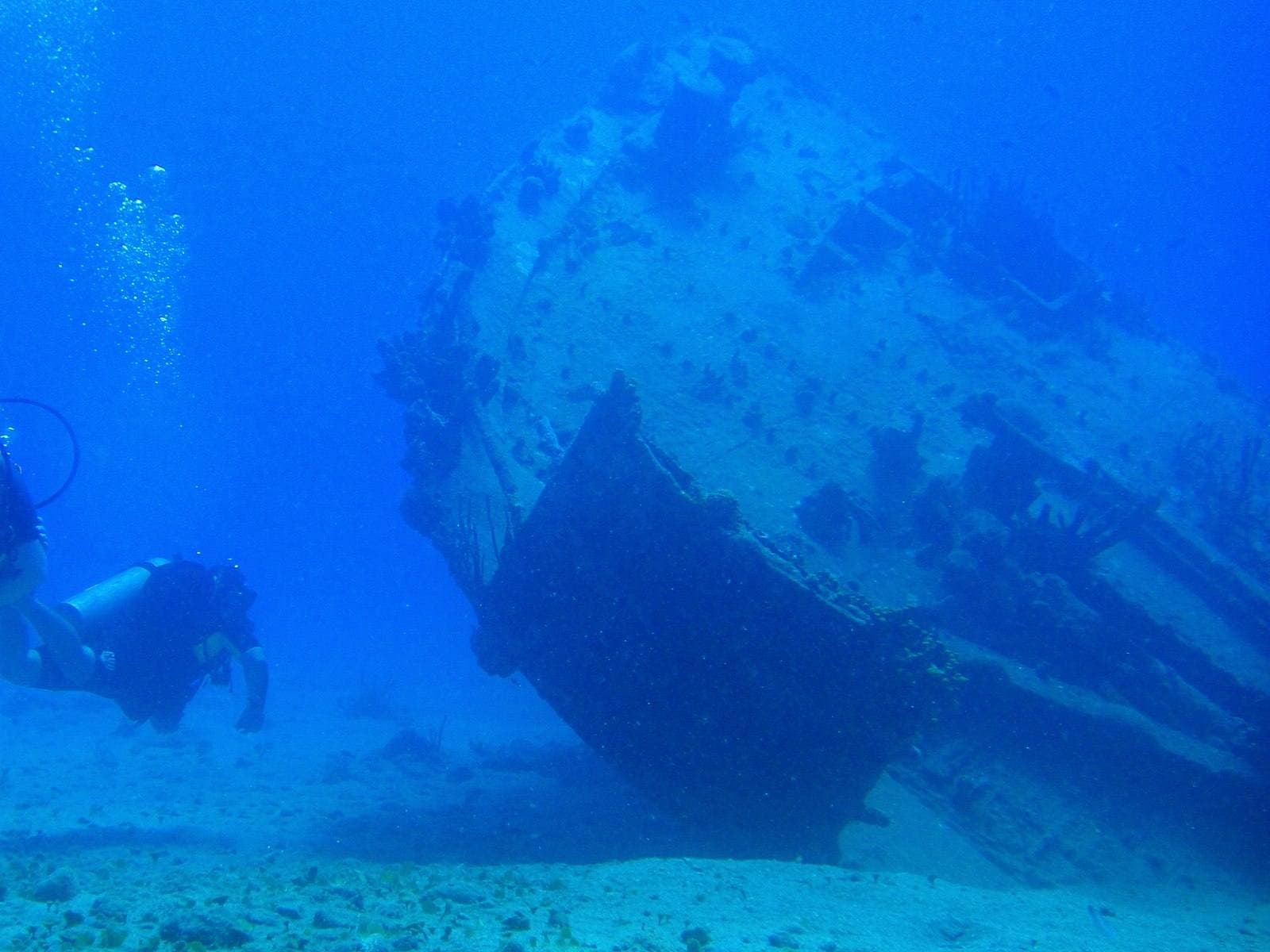
- PapooseTanker torpedoed in 1942, lying upside down at about 35 m; known for large sand tiger sharks.
- SparCoast guard buoy tender sunk as an artificial reef in 2004 at about 33 m; sand tigers often present.
- AeolusNavy cable ship sunk as a reef in 1988 at about 33 m; sand tigers and schooling fish.
- CaribseaFreighter sunk by a U-boat in 1942 off Cape Lookout, about 27 m; sand tigers.
- AtlasTanker sunk in 1942 off Cape Lookout, about 37 m.
- TarponUS Navy submarine that sank under tow in 1957, about 40 m; advanced.
- Proteus (Hatteras)Passenger steamer sunk in a collision in 1918 off Hatteras, about 37 m; close to the Gulf Stream.
- Ashkhabad1917 tanker sunk by U-402 in 1942.
- USS SchurzDeeper offshore gunboat wreck.
- NaecoWWI-built tanker, originally the Charles M. Everest.
- Dixie Arrow (Hatteras)Tanker sunk off Hatteras in 1942; sand tigers and fish.
- U-701 (Hatteras)German U-boat sunk off Hatteras in 1942; deep and current-swept.
- IndraShip sunk as an artificial reef off Beaufort Inlet.
What you'll see
Know the risks
- Long offshore boat rides in open ocean; seasickness
- Strong current and depth; ascend on the line
- Hurricanes and summer thunderstorms
Plan the trip
- Dive shops
Where North Carolina dive centres are based and what to check before you book. Shop list in progress.
How to choose a dive shop - Dates and people
Post your dates and how many of you. Divers who know the boats and shops, or are going the same weeks, reply in the community.
Find divers / ask dates - Dive insurance
Remote sites and strong currents make evacuation costly. Check your policy covers diving to the depth you plan.
Dive accident cover from DAN ↗
Some of these links may earn us a commission at no cost to you. It never changes what we recommend. How this site is funded
Ask other divers
Questions
When is the best time to dive North Carolina?
June to September; most boats run May to October, and winter seas are rough. Peak months on our calendar: June, July, August.
What is the water temperature in North Carolina?
About 22–28°C at depth in summer when the Gulf Stream is close, much colder inshore in winter. 3–5 mm in summer; there can be cold thermoclines.
Can Open Water divers dive North Carolina?
Advanced Open Water; most wrecks lie at 25–40 m, offshore, with current. Nitrox and wreck experience help.
How strong is the current in North Carolina?
Often strong: the Gulf Stream and the Labrador Current meet off Cape Hatteras. Descents on the anchor line.
What should divers watch out for in North Carolina?
Long offshore boat rides in open ocean; seasickness. Strong current and depth; ascend on the line. Hurricanes and summer thunderstorms.
Sources
- Crystal Coast NC: Drive and dive North Carolina (PDF)
- Scuba Diving: Wrecks of the Carolinas
- DeeperBlue: Five of North Carolina's best wreck dives
- Undercurrent: Olympus Dive Center, North Carolina wrecks report
- DiveBuddy: Papoose
- DiveBuddy: U-352
- Visit NC: diving the Graveyard of the Atlantic
Last reviewed 2026-11. Where sources disagree we use the more conservative range.